
The PI Planning Roadmap: The SAFe PI Planning Process
A week-by-week checklist for SAFe PI Planning, from five weeks before to the week itself and what follows.
The SAFe PI Planning Process from 5 weeks out up to the PI Planning boundary is outlined below.
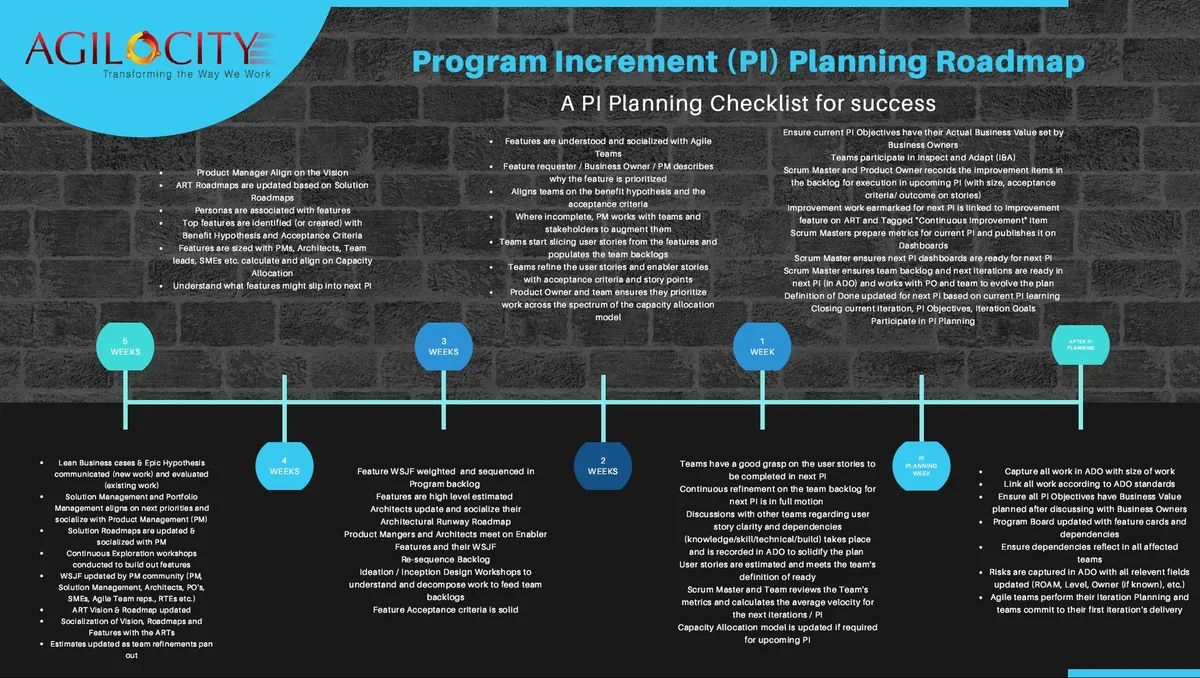
PI Planning roadmap to success
The SAFe PI Planning Process from 5 weeks out
5 Weeks to PI Planning
- Lean Business cases & Epic Hypothesis communicated (new work) and evaluated (existing work)
- Solution Management and Portfolio Management aligns on next priorities and socialise with Product Management (PM)
- Solution Roadmaps are updated & socialised with PM
- Continuous Exploration workshops conducted to build out features
- WSJF updated by PM community (PM, Solution Management, Architects, PO’s, SMEs, Agile Team reps., RTEs etc.)
- ART Vision & Roadmap updated
- Socialisation of Vision, Roadmaps and Features with the ARTs
- Estimates updated as team refinements pan out
4 Weeks to PI Planning
- Product Manager Align on the Vision
- ART Roadmaps are updated based on Solution Roadmaps
- Personas are associated with features
- Top features are identified (or created) with Benefit Hypothesis and Acceptance Criteria
- Features are sized with PMs, Architects, Team leads, SMEs etc. calculate and align on Capacity Allocation
- Understand what features might slip into next PI
3 Weeks to PI Planning
- Feature WSJF weighted and sequenced in Program backlog
- Features are high level estimated
- Architects update and socialise their Architectural Runway Roadmap
- Product Mangers and Architects meet on Enabler Features and their WSJF
- Re-sequence Backlog
- Ideation / Inception Design Workshops to understand and decompose work to feed team backlogs
- Feature Acceptance criteria is solid
2 Weeks to PI Planning
- Features are understood and socialised with Agile Teams
- Feature requester / Business Owner / PM describes why the feature is prioritised
- Aligns teams on the benefit hypothesis and the acceptance criteria
- Where incomplete, PM works with teams and stakeholders to augment them
- Teams start slicing user stories from the features and populates the team backlogs
- Teams refine the user stories and enabler stories with acceptance criteria and story points
- Product Owner and team ensures they prioritise work across the spectrum of the capacity allocation model
1 Week to PI Planning
- Teams have a good grasp on the user stories to be completed in next PI
- Continuous refinement on the team backlog for next PI is in full motion
- Discussions with other teams regarding user story clarity and dependencies (knowledge/skill/technical/build) takes place and is recorded in ADO to solidify the plan
- User stories are estimated and meets the team’s definition of ready
- Scrum Master and Team reviews the Team’s metrics and calculates the average velocity for the next iterations / PI
- Capacity Allocation model is updated if required for upcoming PI
Week of PI Planning
- Ensure current PI Objectives have their Actual Business Value set by Business Owners
- Teams participate in Inspect and Adapt (I&A)
- Scrum Master and Product Owner records the improvement items in the backlog for execution in upcoming PI (with size, acceptance criteria/ outcome on stories)
- Improvement work earmarked for next PI is linked to Improvement feature on ART and Tagged “Continuous Improvement” item
- Scrum Masters prepare metrics for current PI and publishes it on Dashboards
- Scrum Master ensures next PI dashboards are ready for next PI
- Scrum Master ensures team backlog and next iterations are ready in next PI (in ADO) and works with PO and team to evolve the plan
- Definition of Done updated for next PI based on current PI learning
- Closing current iteration, PI Objectives, Iteration Goals
- Participate in PI Planning
After PI Planning
- Capture all work in ADO with size of work
- Link all work according to ADO standards
- Ensure all PI Objectives have Business Value planned after discussing with Business Owners
- Program Board updated with feature cards and dependencies
- Ensure dependencies reflect in all affected teams
- Risks are captured in ADO with all relevant fields updated (ROAM, Level, Owner (if known), etc.)
- Agile teams perform their Iteration Planning and teams commit to their first iteration’s delivery